IoT Connectivity Explained: Uptime at the Edge

Stephen Mammen, Vice President of Engineering
Uptime is the number every industrial IoT deployment gets judged on, and it comes down to three specific things: coverage, failover, and visibility. If a device stays online through a rough week, it’s not “lucky” — those three are just doing what they’re supposed to. A device that goes dark usually means one of them failed.
The goal of this blog is to break IoT connectivity down in simple terms: what it is, why remote devices lose it, and what determines whether yours stay online when it counts.
Dealing with a connectivity issue right now? Let’s get it Solved →
What is IoT connectivity?
IoT connectivity is the network layer — cellular, satellite, or both — that lets a remote device like a sensor, a controller, or a SCADA endpoint send and receive data without a technician physically going to the site.
In industrial contexts, “connectivity” isn’t as simple as internet access. It’s the combination of a SIM or radio, a carrier network (or several), and a management layer that together determine whether a device stays reachable. The gap between when a device stops reporting and when someone notices is where uptime is won or lost.
Why do remote industrial devices lose connection?
Remote devices lose connection for three recurring reasons:
- A single carrier with a coverage gap at that specific site
- A dead zone where no cellular signal reaches at all
- A data plan that throttles the device right as it needs to send data
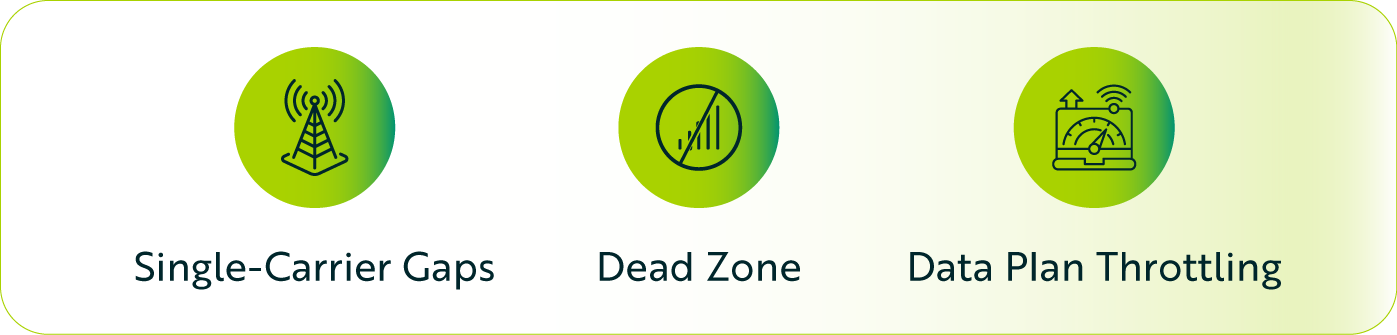
Single-carrier gaps are the most common cause. The device might be provisioned and configured correctly, but if that one carrier has a local outage, a tower goes down for maintenance, or the site sits in a weak-signal pocket for that network, the device has no other option than to go dark.
Dead zones are different. No carrier reaches the site at all — meaning you’re not dealing with a weak signal, you’re dealing with no signal. This is common at the edge: remote well pads, offshore platforms, rural stretches with no tower in range. Switching carriers doesn’t help, because there’s no carrier to switch to.
There’s a third cause that can be easy to miss: a data plan that throttles a device during an alarm event or a pressure spike, exactly when the data matters most. What often appears as a sensor malfunction is more than likely a network problem. Learn more about throttling →
How does a multi-network SIM / carrier failure improve uptime?
Multi-network failover puts one SIM on several carrier networks instead of one, so the device can automatically use whichever network has the strongest signal wherever it sits — and has the ability to switch again the second that network drops — without anyone touching the hardware.
Rather than betting a device’s uptime on one carrier’s coverage map, the device can see every network available to it and stays connected. No manual SIM swap, no truck roll, no stretch of time where the device sits dark waiting for a human to catch up. For a fleet spread across a large footprint, this single change usually does more for uptime than anything else on the list, because it fixes the most common issue without new hardware or a new system to manage.
When do you need satellite instead of (or with) cellular?
You need LEO satellite connectivity when a site has no cellular coverage at all, or when the coverage that does exist is unreliable enough that running cellular as primary with satellite as backup is worth the added cost. Failover fixes weak coverage, while satellite addresses the absence of coverage.
The difference matters if or when you’re deciding what to do about a specific site:
- Spotty single-carrier coverage is a Multi-Network SIM fix — satellite isn’t usually necessary there
- Zero coverage at all, common at the far edge of a footprint, is a satellite problem, since there’s no signal to fail over to in the first place
Many teams end up needing both: cellular covering most sites, with satellite reserved for the handful cellular can’t reach.
How do you get visibility into connectivity at the edge?
Visibility comes from a connectivity management platform that shows the status, signal strength, and data usage of every device in one place, so you find out about a problem from the platform first.
Multi-network SIM and satellite connectivity settle whether a device can get online. Neither one tells you when it drops or why — that’s what a good platform is for. Staying connected and knowing what’s happening with that connection are two different problems, and the teams with the best uptime numbers are usually those who caught the issue early.
The bottom line: uptime at the edge requires coverage, failover, and visibility — in that order.
If you start with the wrong coverage, nothing downstream can fully compensate.
If you don’t have a backup plan, you’re scrambling the minute something goes wrong.
If you can’t see when something goes wrong, your uptime quickly drops.
Not sure where your network stands? That’s where our connectivity experts come in.
FAQs
What’s the difference between IoT connectivity and Wi-Fi or broadband?
Wi-Fi and broadband depend on fixed infrastructure — a router, a modem, a wired line into a building. IoT connectivity, usually cellular or satellite, doesn’t need any of that. A device gets online wherever it physically sits, which is the only reason a well pad or a moving asset can report back at all.a
How reliable is cellular failover compared to a single carrier?
More reliable, because it removes the single point of failure a one-carrier setup always has. A device on one network goes dark the moment that carrier has a local problem. A device with failover just moves to another available network instead.
Do industrial IoT devices need satellite connectivity everywhere?
No. Most industrial sites have workable cellular coverage, and multi-network SIM handles those fine on its own. LEO satellite connectivity applies specifically where cellular doesn’t reach at all.
How much does IoT connectivity typically cost per device?
It depends on data volume, whether the SIM is pooled or pay-per-use, and whether satellite is involved. Quotes are available by request here.
About the Author

Stephen Mammen, VP of Engineering
Stephen Mammen is a seasoned engineering leader with more than two decades of experience designing and managing complex connectivity and IoT solutions. As Vice President of Engineering at Solve Networks, he oversees the technical backbone that powers multi-network SIMs, eSIM solutions, and private networks — ensuring customers have secure, resilient, and scalable connectivity for even the most demanding deployments. During his time at Solve, Stephen has strengthened the company’s technical foundation, scaled network operations, and helped build innovative solutions that keep devices and systems connected across multiple carriers and geographies.