Satellite vs. Cellular

How to Choose the Right Connectivity for Your Business
When it comes to connectivity, one of the biggest mistakes organizations make is trying to pick the “better” option based on generic charts and spec sheets. The truth is, there’s no universal answer.
Satellite and cellular networks solve different problems—and increasingly, they solve some of the same problems in different ways. Choosing the wrong approach for your environment can cost you time, money, and productivity. The better question to ask is:
Which technology fits your location, application, data requirements, and risk tolerance?
This guide is designed to help you answer that question, and understand when the best solution is actually both.
Comparing Satellite and Cellular
Satellite: Broadband Without Traditional Infrastructure
LEO satellite connectivity delivers broadband via low-Earth orbit satellites, allowing connectivity almost anywhere there’s a clear view of the sky. Because it doesn’t rely on fiber, cable, or nearby cell towers, it can be deployed quickly and independently of local infrastructure.
Why organizations choose satellite:
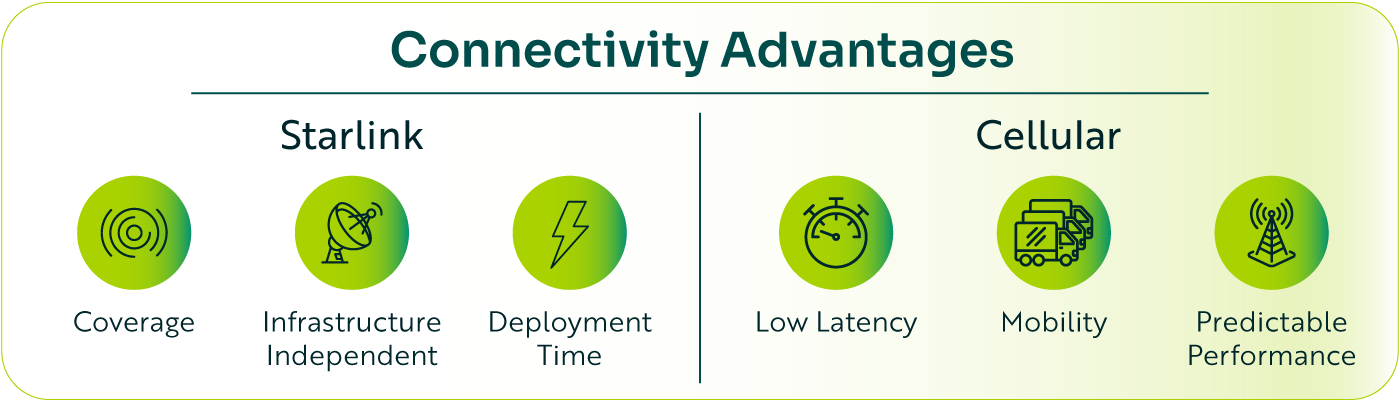
- Coverage flexibility: Works in remote, rural, offshore and many urban or suburban environments
- Infrastructure independence: No reliance on local ISPs or carrier towers
- High-throughput data plans: Well suited for large data volumes and bandwidth-intensive use cases
- Rapid deployment: A dish and power can bring a site online in hours
While satellite connectivity is often associated with fixed remote sites, it can also support mobile and semi-mobile applications, including vehicles, vessels, and temporary deployments. Performance can fluctuate due to weather, obstructions, or satellite handoffs, and latency is generally higher than terrestrial networks—but for many use cases, those tradeoffs are acceptable.
Satellite is especially valuable when coverage gaps exist, when large amounts of data need to move reliably, or when network independence and speed of deployment matter more than ultra-low latency.
Cellular: Scalable, Mobile, and Latency-Sensitive
Cellular connectivity—LTE, LTE-M, and 5G—is built on terrestrial carrier infrastructure. When coverage is strong, it delivers low latency, predictable performance, and seamless mobility.
Why organizations choose cellular:
- Low latency: Ideal for real-time control, voice, and video
- Mobility by design: Vehicles, fleets, and moving assets stay connected without line-of-sight requirements
- Data plan flexibility: Scales from very small IoT data usage to large pooled or unlimited plans
- Predictable performance: Strong in urban and suburban areas with dense carrier coverage
Cellular excels when applications are latency-sensitive or highly mobile, and when granular control over data usage and cost is required. However, performance is tied to tower availability, congestion, and carrier coverage, which can vary dramatically by location.
Key Considerations Before Choosing
Location still matters—but it’s no longer binary.
Satellite is no longer limited to “middle of nowhere” deployments. It works in many urban and suburban environments and is often used to add network diversity or rapid capacity. Cellular, meanwhile, delivers excellent performance where coverage exists but can struggle in rural, offshore, or undeveloped regions.
Application requirements are critical.
Satellite is well suited for telemetry, data collection, backhaul, and environments where the priority is moving large volumes of data reliably. Cellular is a better fit for real-time control, interactive applications, voice, video conferencing, and latency-sensitive IoT workloads.
Mobility looks different on each network.
Cellular is purpose-built for mobility and excels with moving assets. Satellite can support mobile use cases as well, particularly in environments where cellular coverage is intermittent or nonexistent—but it requires different planning and expectations.
Data consumption and cost control shouldn’t be overlooked.
Satellite generally offers large, high-capacity data plans, making it a strong option when bandwidth demand is high and predictable. Cellular offers much more flexibility, scaling from very small data plans for sensors and monitoring up to large enterprise deployments—often making it the better choice for mixed or highly distributed device fleets.
Redundancy is where the lines blur.
Both technologies have failure modes. Cellular networks can suffer from congestion or outages; satellite performance can fluctuate due to environmental factors. Many organizations achieve the highest reliability by combining both: using satellite as a primary connection with cellular backup, or cellular primary with satellite failover, depending on the site and application.
Deployment speed vs. long-term stability matters.
Satellite can be live quickly, making it ideal for disaster response, temporary sites, or rapid expansion. Cellular deployments may take longer to provision but offer long-term predictability, policy control, and integration with enterprise mobility strategies.

Satellite vs. Cellular in Real Life
So, how are businesses leveraging each technology in practice?
Satellite is frequently used for remote energy and industrial sites, construction projects, emergency response, temporary facilities, and locations where terrestrial connectivity is limited or unreliable. In these environments, it enables connectivity where options were previously constrained or nonexistent.
Cellular remains the foundation for urban and suburban operations, mobile fleets, latency-sensitive applications, and large IoT deployments that require flexible data plans and tight cost control.
Increasingly, organizations are using both, not as competing technologies, but as complementary layers in a resilient network design.
Solve’s Take: The Answer is Often Both
For many organizations, the most effective connectivity strategy isn’t choosing satellite or cellular. It’s designing an architecture that uses both intelligently.
Hybrid networks allow traffic to route based on performance, availability, and application priority. Some sites run satellite as the primary connection with cellular failover. Others rely on cellular day-to-day and use satellite as a diverse backup path. The right design depends on the environment, risk tolerance, and operational impact of downtime.
Solve Networks doesn’t push one technology over another. We design connectivity strategies around how your business actually operates—today and as it scales. Whether that means deploying satellite for coverage and bandwidth, optimizing multi-carrier cellular for mobility and low latency, or building a hybrid network with intelligent failover and traffic prioritization, Solve engineers networks that perform in the real world.
From assessment and design to deployment and ongoing support, Solve helps organizations reduce downtime, eliminate blind spots, and build resilient connectivity that adapts as conditions change.