From Coverage Gambles to Global Visibility: A Heat-Treatment Connectivity Case Study

Michael Crayton, National Sales Account Manager
Most people think connectivity is a SIM card and a little luck. Pick a carrier, hope the bars show up when you need them, and cross your fingers at the job site. That’s not what we do at Solve Networks — and it’s definitely not what we built for one of our heat treatment customers.
Let’s talk about why.
The Challenge: A Job Site You Can’t Predict
This customer sends technicians to offshore rigs, refineries, and industrial plants to do heat treatment on wells and pipes. If you don’t know that world, here’s why it matters: miss the target temperature on a well or pipe and you’re not just redoing the work. You’re looking at a compromised material, a safety issue, or a client who doesn’t call you for the next job.
Their operations center runs and monitors that equipment remotely. That means a steady stream of sensor data has to make it off the job site, whether a technician is standing there or not. The work doesn’t pause because the connection is bad.
And here’s the part that should sound familiar to anyone in industrial operations: you don’t get to pick your job site’s coverage. Offshore rigs and refineries aren’t exactly known for reliable cell service, so every new location was a gamble.
The Solution: Building a Kit, Not Reselling a SIM Card
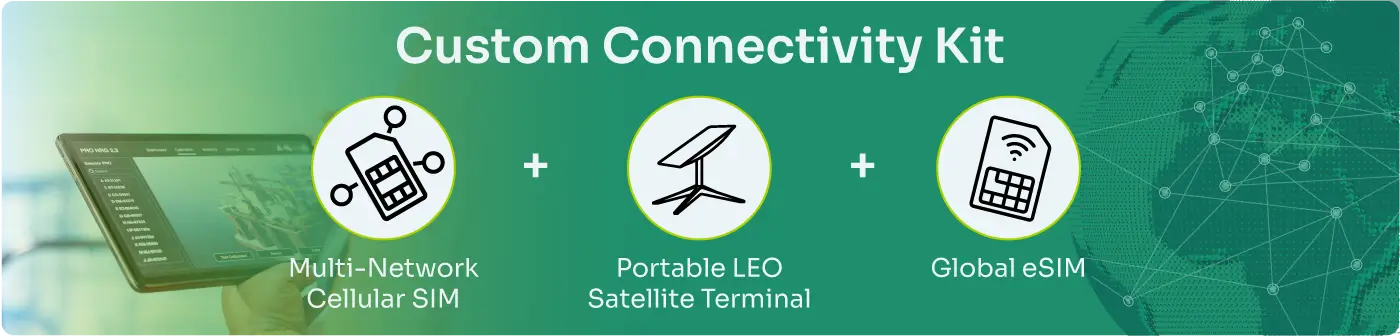
You can’t fix an issue like that with a single SIM card, so we didn’t try to. What Solve delivers is a fundamentally different approach: we built this customer a kit, not a product.
It started with a multi-network cellular SIM, so the crew wasn’t betting the job on a single carrier having decent coverage at whatever remote site they landed at that week. Then, for the sites where cellular wasn’t going to cut it — and offshore, that’s often — we added a portable LEO satellite connectivity terminal right into the same kit. No extra setup, no separate gear to remember, and the technician shows up with everything they need already in hand.
This customer also works globally, so we layered in Solve’s global eSIM solution, which gives them multi-network connectivity in up to 200 countries and territories. They get the same reliable setup whether the job is down the road or on the other side of the world.
The Result: From Guessing Games to Global Visibility
The operations center now has full visibility into every job in progress, all the time. For the crew on site, it means one less thing to worry about on a job that already demands their full attention. They’re not troubleshooting a connection on top of hitting an exact temperature.
This story highlights the difference between a connectivity vendor and a connectivity partner. A vendor sells you a SIM card and wishes you luck, while a partner builds the whole kit around the job you actually have to do. If you’re ready to stop gambling on connectivity, talk to Solve Networks today.
About the Author

Michael Crayton, National Sales Account Manager
Michael Crayton is the National Sales Account Manager at Solve Networks, where he’s responsible for bringing in new business and making sure customers are getting the most out of their connectivity. Before joining Solve in 2025 as the company’s first salesperson, Michael spent over a decade at an industrial communications distributor, building a hands-on foundation in cellular routers, gateways, network design, and security consultation for mission-critical industrial applications. Outside of work, Michael is a hockey referee, an avid traveler, and a self-described enthusiast of trying new restaurants. He holds a degree in political science and — in another life — would have gone to law school.